Showing posts with label Mars. Show all posts

Saturday, May 13, 2017

Terraforming Mars


From Martyn J. Fogg's Terraforming Website

Mars is currently a world gripped in a perpetual ice age. On the surface, Mars is a freeze-dried world of rocks, ice, and dust. At first glance it looks like the least likely place to plant a garden. But rocks and minerals found by the Mars rovers show it may have had a warmer and more clement environment conducive to life. 

Today on Far Future Horizons we take another exciting look at the possibility of transforming the planet Mars into a second planetary abode for humanity and the other life forms of our planet. What would it take to Terraform the red planet and bring life to Mars and Mars to life?


Sunday, March 12, 2017

Mars: The Secret Science ~ Mars' Deepest Mysteries

Mars InSight Mission


Today on Far Future Horizons we present the fourth instalment of “Mars: The Secret Science”.


We examine what lies beneath Mars’s surface and uncover answers to some of the mysteries that have stumped scientists for decades.

Saturday, November 19, 2016

Friday, September 2, 2016

Man on Mars - Mission to the Red Planet


Today on Far Future Horizons we present another exciting episode of the acclaimed BBC science documentary series Horizon.

This instalment of Horizon goes behind the scenes at NASA to discover how it is preparing for its most ambitious and daring mission: to land men - and possibly women - on the surface of Mars.

Wednesday, July 20, 2016

Saturday, March 19, 2016

A Traveler's Guide to the Planets Episode 1 Mars


Today on Far Future Horizons we will be beginning the ultimate grand tour of the entire solar system with the first installment of a marvelous documentary series entitled “A Traveler's Guide to the Planets”.


Greetings From Mars


Today in Episode 1 we explore the planet Mars.


Saturday, March 5, 2016

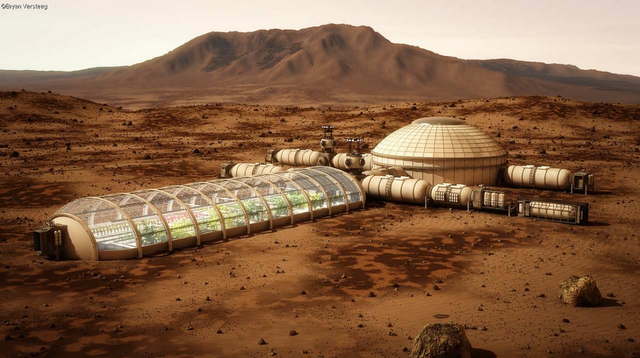
Colonizing Mars

Copyright Bryan Versteeg Mars One

Today on Far Future Horizons we present an excerpt from a feature documentary titled Someday Somewhere Beyond which explores the history and future of space colonies.


Copyright Bryan Versteeg Mars One


Someday Somewhere Beyond was directed and edited by Jonathan Minard, and has some wonderful conceptual animation by artist Bryan Versteeg and features interviews with Robert Zubrin and Margarita Marinova.


Sunday, February 28, 2016

Robinson Crusoe on Mars


Today on Far Future Horizons we present the SciFi classic Robinson Crusoe on Mars.

Robinson Crusoe on Mars, is a 1964 Techniscope science fiction film, which is the retelling of the classic Daniel Defoe novel. It was directed by Byron Haskin, produced by Aubrey Schenck and starred Paul Mantee, Victor Lundin and Adam West (of Batman fame).

Robinson Crusoe on Mars is all time childhood Sci Fi favourite of mine and I have fond memories of watching this motion picture as a child when it was shown as a Saturday morning television matinee feature. 


It was released on DVD for the first time as a special edition from The Criterion Collection on September 18, 2007.

Sunday, February 7, 2016

Deep Space Probes


Today on Far Future Horizons we follow deep space probe missions to the planet Mars and Saturn's moon, Titan, in hope of answering a most fundamental question: Is there life elsewhere in our solar system?


Tuesday, September 29, 2015

Mars Waterworld


Today on Far Future Horizons, in light of this recent discovery, we present another exciting episode of the acclaimed science series Naked Science that focuses on NASA’s mission Phoenix, to Mars and its searching for water to determine if the planet has sustained life in the past.

On May 25, 2008, NASA's Phoenix Lander  entered the Martian atmosphere and landed on its polar ice-cap in the last phase of a historic mission to investigate Mars' past by digging down into the soil and ice - something that has never been done before. 

Saturday, August 29, 2015

Our Greatest Adventure

The Hermes Spacecraft from the film "The Martian".

Today on Far Future Horizons we present "Our Greatest Adventure" hosted by Neil deGrasse Tyson.


This is  an excellent viral movie campaign for the motion picture "The Martian" starring Matt Damon, Jessica Chastain, Kristen Wiig, Jeff Daniels, Michael Peña, Kate Mara, Sean Bean, Sebastian Stan, Aksel Hennie, Donald Glover, Mackenzie Davis, and Chiwetel Ejiofor.


Friday, April 24, 2015

Pioneer One ~ Earthfall & The Man from Mars

A Cold War relic returns amid fears of terrorism but turns out to be a forgotten Soviet space mission. What it brings back will have implications for the entire world.


Today on Far Future Horizons it gives us great pleasure to present the first two episodes of the fabulous SciFi web series Pioneer One (2010) produced by Josh Bernhard and Bracey Smith. It is a series that has been entirely funded through donations, and is the first series created for and released on Bit Torrent networks.


Pioneer One is a serialized drama produced and distributed online through VODO and the DISCO network. Downloaded more than 3,730,000 times since May 2012 and winner for Best Drama Pilot at the 2010 New York Television Festival, the show is independently produced and financed by viewer donations. The pilot episode was filmed on a budget of $6,000, raised in advance using Kickstarter. The series itself was released under a Creative Commons license and is distributed for free in collaboration with VODO, as with Bernhard's previous independent film The Lionshare, over the Internet including peer-to-peer networks. So far, six episodes have been produced. Production of the rest of the season is funded through direct donations from the fan base.


The plot that surrounds the entire series involves a mysterious spaceship entering the Earth's atmosphere, triggering a massive response from the American government. Since the ship has spread radiation over hundreds of miles of rural Montana, officials are quick to bring up the possibility of a terrorist attack, specifically the detonation of a dirty bomb, however, that idea is discarded subtly by the leading investigator, asking the rhetorical question "Who would launch an attack on Montana?".

Debris is found in Canada, where an investigation of the crash discovers a live human being in a Soviet space suit. Federal agents working for the American Department of Homeland Security get involved, receiving permission from the Royal Canadian Mounted Police to operate in Canada. The man is in an unstable condition and his initial blood work shows signs of severe cancer, with his doctors proclaiming him too badly injured to transport. A note handwritten in Russian found at the crash site says that the man is the child of cosmonauts living at a base on Mars. Not believing the note and wanting to announce a Department of Homeland Security success to the press, the American DHS orders Agent Taylor to bring the man back to the United States as a suspected terrorist, despite his severe condition. Believing the note could be true, Taylor ignores his orders and destroys the permission from the RCMP, forcing his team to stay on site.

Sunday, October 26, 2014

Monday, October 20, 2014

Carl Sagan’s Cosmos ~ Blues for a Red Planet

Carl Sagan with a mock up of the Viking Mars Lander

Today on Far Future Horizons we present the fifth episode of Carl Sagan’s highly acclaimed PBS documentary series – Cosmos: Blues for a Red Planet.


Percival Lowell

Is there life on Mars? Dr. Sagan takes viewers on a tour of the red planet first through the eyes of science fiction authors, and then through the unblinking eyes of two Viking spacecrafts that sent thousands of pictures of the stunning Martian landscape back to Earth in 1976. 


Though based on older Mars missions, Sagan’s analysis still holds true.

Monday, September 1, 2014

The Universe: Mars the Red Planet


Today on Far Future Horizons we present an episode of the highly acclaimed documentary series “The Universe” .

The focus of today's instalment is the fourth planet in distance from the Sun, the Red Planet - Mars.


Thursday, May 1, 2014

Exodus Earth ~ Mars


Mars is a world that holds a special mystique for humanity. We have been held under its captive spell for over a century. It is the one world where humanity expected to find life and sentience beyond the Earth. And, in the minds of many space visionaries today, Mars is the one world most likely to sever as a secondary planetary abode for terrestrial life and consciousness.


The colonization of Mars has been the topic of both romantic speculation and serious scientific study before the dawn of the Space Age. But, it has only been during the past forty years, beginning with observations of Mariner 9 and culminating with recent space missions of Mars Odyssey, Mars Express and the Mars Reconnaissance Orbiter, that we can now assess the full resource potential of this world. 

Sunday, March 16, 2014

Robert H. Goddard ~ Via Cherry Tree To Mars


On the afternoon of October 19, 1899, I climbed a tall cherry tree at the back of [my uncle’s] barn and, armed with a saw and hatchet, started to trim the dead limbs from the tree. It was one of those quiet, colorful afternoons of sheer beauty which we have in October in New England and, as I looked toward the fields to the east, I imagined how wonderful it would be to make some device which had even the possibility of ascending to Mars, and how it would look on a small scale if sent up from the meadow at my feet . . . I was a different boy when I descended the ladder. Life now had a purpose for me. ~ Robert H. Goddard


“It is difficult to say what is impossible, for the dream of yesterday is the hope of today and the reality of tomorrow.” ~ Robert H. Goddard US physicist & pioneer rocket engineer (1882 - 1945)


Robert H. Goddard had just turned seventeen some two weeks before that lazy afternoon on that exquisite New England autumn and when he climbed down from that cherry tree he henceforth dedicated his life to one purpose, the creation of some device that would one day take people to the planet Mars.


Some twenty seven years later on March 16th, 1926, a date just as significant to the history of astronautics as December 17th, 1903 (when the Wright brothers took to the air in the first heavier than air flying machine) is important in the history of aeronautics, Robert H. Goddard created that device when he launched the world’s first liquid fueled rocket.  This rocket, which was dubbed "Nell," rose just 41 feet (12.5 meters) during a 2.5-second flight that ended up in a cabbage field on his aunt’s farm. Yet, that first flight was a small technical step and giant technological leap that would one day take men to the Moon and eventually, sometime in this century, take humans to Mars.

Robert H. Goddard, bundled against the cold New England weather of March 16, 1926, holds the launching frame of his most notable invention — the first liquid rocket.
Robert H. Goddard with one of his rocket's (Hand Tinted Photograph)


Today on Far Future Horizons, we commemorate the eighty-eighth anniversary of the launching of the world’s first liquid fueled rocket by presenting two special video features: the biographical documentary “The Dream That Wouldn't Down” and the fifth episode of Carl Sagan’s acclaimed documentary series Cosmos – “Blues for a Red Planet."


Monday, March 10, 2014

Mars Alive


Today on Far Future Horizons we take an exciting look at the possibility of transforming the planet Mars into a second planetary abode for humanity and the other life forms of our planet. What would it take to Terraform the red planet and bring life to Mars and Mars to life?


Terraforming (literally, "Earth-forming") of a planet, moon, or other body is the hypothetical process of deliberately modifying its atmosphere, temperature, surface topography or ecology to be similar to those of Earth to make it habitable by terran organisms.


The term is sometimes used more generally as a synonym for planetary engineering, although some consider this more general usage an error. The concept of Terraforming developed from both science fiction and actual science. The term was coined by Jack Williamson in a science-fiction story ("Collision Orbit") published during 1942 in Astounding Science Fiction, but the concept may pre-date this work.


Mars as it is now and after its Terraformation