Showing posts with label Terraforming. Show all posts

Saturday, May 13, 2017

Terraforming Mars


From Martyn J. Fogg's Terraforming Website

Mars is currently a world gripped in a perpetual ice age. On the surface, Mars is a freeze-dried world of rocks, ice, and dust. At first glance it looks like the least likely place to plant a garden. But rocks and minerals found by the Mars rovers show it may have had a warmer and more clement environment conducive to life. 

Today on Far Future Horizons we take another exciting look at the possibility of transforming the planet Mars into a second planetary abode for humanity and the other life forms of our planet. What would it take to Terraform the red planet and bring life to Mars and Mars to life?


Saturday, March 5, 2016

Colonizing Mars

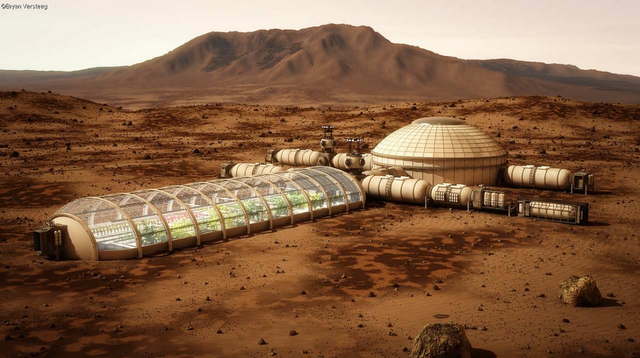
Copyright Bryan Versteeg Mars One

Today on Far Future Horizons we present an excerpt from a feature documentary titled Someday Somewhere Beyond which explores the history and future of space colonies.


Copyright Bryan Versteeg Mars One


Someday Somewhere Beyond was directed and edited by Jonathan Minard, and has some wonderful conceptual animation by artist Bryan Versteeg and features interviews with Robert Zubrin and Margarita Marinova.


Monday, February 22, 2016

Deadliest Planets


Today on Far Future Horizons we will explore some of the most dangerous and hostile planets in our solar system. The planets Venus, Jupiter and Neptune are worlds that will present many perils and challenges to future intrepid Astronauts. How were they were formed, why are they are so deadly and why can they not sustain life?

Friday, January 15, 2016

Can We Survive the Death of the Sun?


Today on Far Future Horizons we join veteran actor Morgan Freeman in an outstanding episode of the acclaimed Science Channel documentary series “Through the Wormhole” which explores the question - Can We Survive the Death of the Sun?

The focus of this installment of Through the Wormhole is the survival of humanity (or whatever  we evolve to become) into the far distant future, as measured on geological and cosmological timescales, by developing the technology to move to another planet, a new "Earth" or star system in order to survive the death of our central star, The Sun.


Saturday, November 15, 2014

Sci-Fi Science - Earth 2.0


Today on Far Future Horizons we present another episode of Dr. Michio Kaku’s Sci Fi Science and explore the exciting possibility of Terraforming the planet Mars.


In this first instalment of the second season of Sci Fi Science, Dr. Michio Kaku comes up with plans for the construction of Earth 2.0 (a second Earth) through the process of terraforming.


Monday, November 3, 2014

Earth Overhaul


It is claimed by some scientists that climate change is being felt the world over and if global warming continues the effects could be catastrophic.

Some scientists and engineers are proposing radical, large-scale ideas that could save us from disaster. Although these ideas might have unknown side effects, some scientists believe we may soon have no choice but to put these radical and controversial plans into action.

Will humanity engage in a massive program of Planetary and climatic engineering, in order to maintain the natural life support systems that sustain humanity and the other life forms that call this Earth home?

In essence will humanity embark on a program of Terraforming the Earth?

Monday, March 10, 2014

Mars Alive


Today on Far Future Horizons we take an exciting look at the possibility of transforming the planet Mars into a second planetary abode for humanity and the other life forms of our planet. What would it take to Terraform the red planet and bring life to Mars and Mars to life?


Terraforming (literally, "Earth-forming") of a planet, moon, or other body is the hypothetical process of deliberately modifying its atmosphere, temperature, surface topography or ecology to be similar to those of Earth to make it habitable by terran organisms.


The term is sometimes used more generally as a synonym for planetary engineering, although some consider this more general usage an error. The concept of Terraforming developed from both science fiction and actual science. The term was coined by Jack Williamson in a science-fiction story ("Collision Orbit") published during 1942 in Astounding Science Fiction, but the concept may pre-date this work.


Mars as it is now and after its Terraformation 


Wednesday, January 29, 2014

Five Ways To Save The World


How will humanity survive the coming century if our global civilization never manages to overcome its addiction to fossil fuels, curb carbon emissions and global warming continues unabated? What effect will a four degree Celsius rise in temperature have for our planet and the future prospects of our world’s ability to support and sustain a global population of some nine billion people?


The World: 40C Warmer

According to an article by Gaia Vince from the weekly science magazine New Scientist of February 25, 2009 the human species is facing a major existential risk that places our long term future into question. We face a nightmarish scenario:


ALLIGATORS basking off the English coast; a vast Brazilian desert; the mythical lost cities of Saigon, New Orleans, Venice and Mumbai; and 90 per cent of humanity vanished. Welcome to the world warmed by 4 °C.

The Earth of the year 2099 may be so altered by global warming and sea level rise that the carrying capacity of our planet is debilitated to the extent that we may see a massive die off of the human species and may face the prospect of a massive relocation effort of its surviving members to the few remaining slivers of land that can sustain them.

If humanity does indeed face such a bleak prospect then it has clearly reached the point in its history where it must take a more active role in managing its planet and all its life sustaining resources as well as the activities of its inhabitants on an unprecedented scale.


Clearly this is a vision of the future that no one wants, but it might happen. Fearing that the best efforts to curb greenhouse gas emissions may fail, or that planetary climate feedback mechanisms will accelerate warming, some scientists and economists are considering not only what this world of the future might be like, but how it could sustain a growing human population. They argue that surviving in the kinds of numbers that exist today, or even more, will be possible, but only if we use our uniquely human ingenuity to cooperate as a species to radically reorganise our world.